Last week, my Mom and I noticed hundreds of cardboard cases being unloaded from big truck into our neighbors flat. Curious, we asked him what they were. “I'm selling bottles of water now,” the young entrepreneur explained. “Great. We'll take 12,” my Mom exclaimed. “But that's heavy, no?” she added. “No worries,” he said. “I'll deliver it.” Twelve bottles came up three flights of stairs. We handed him one hundred rupees for the 90 rupee case. As he fished around for the ten rupees change, Mom said, “Forget it, delivery charges.” And thus begins the cycle of many empty plastic bottles. But I will only tell you about one bottle in particular.
Within no time, I began to fret about the garbage that we were creating. Garbage pickup is virtually nonexistent here. However, when it comes to bottles, it is a different story. Yesterday, Mom threw one of our empties over the balcony. I cringed with guilt. “Don't worry, Chris,” she said. “Haven't you seen the women who come along in the morning with their huge nylon sacks to collect plastic and glass to sell to recycling? You watch.”
From three stories up the bottle gleamed on the asphalt road. It laid there all alone, abandoned. Suddenly I heard a noise. A boy was kicking the bottle down the road, running after it, kicking it again, running, kicking, running. At the end of the lane, he tired of the game and left it lying on the side of the road. It laid there, abandoned again, waiting.
A barefooted woman in a sari tied up like a dhoti came along and picked up the bottle. She immediately went to the tap in our compound and filled it up with water. Carrying it home to her reed hut, she began to chop some wood and light a fire with dried moss. She measured out half milk and half water from the bottle and added some tea leaves. Within minutes, she squatted with the man of the house, perhaps her husband, brother or son and together, they drank their hot chai in thick clear glasses.
Before long,the man of the house hurried down the road with the other half of the bottle of water, heading into the jungle for his daily bowel movement. Now I know why he needs the bottle, but in case you don't I will explain. He fastidiously wiped his bum with his left hand and then used the water to carefully wash his fingers, making sure that nothing had been caught under his nails. Hence why you only eat food with your right hand in India.
I hate to tell you but the fated bottle came back to the reed house, too valuable to be tossed. The woman in the worn sari rushed back to the water tap. The next day, however, that precious bottle was needed again. Their son had come down with a fever. She took the empty bottle to a local dukhan and sold it to the shopkeeper. With her one rupee, she bought a pill for her son.
Fortunately for the bottle, it was still undamaged. Its lid still intact. A worker from the dukhan took the bottle to the petrol station and filled it with gas. For half a day, the bottle proudly sat on a table by the road, glistening in the sun. A timely maneuver, because in the late afternoon, a woman with red hair pulled up on her scooter, low on gas. The bottle glugged its amber liquid into the tank. The woman paid for the precious bottle of gas and drove off in a hurry. Meanwhile, the bottle has been thrown onto the ground. Is this the end of the bottle's journey? I doubt it because it has still not been picked up by the woman with the nylon bag.
Saturday, October 23, 2010

Tuesday, October 19, 2010

Bangladesh
After ten days in Kathmandu, we repacked our bags and headed for yet another airport to fly to Bangladesh. I had some work to complete there for both my social justice work and also the book that I am currently working on. Arriving at the airport entrance and before we could enter, our luggage had to be screened at an x ray machine. The next step was check in, sending off our x-rayed luggage. All our hand luggage was tagged. The next stage...more x-rays. But thank God, there was a woman’s line as the man's stretched way back. The technician rifled through my bag, then waved me on. Just when we thought we were finished, we had to go to a long table and in front of some women guards, every single item in our carry on bags had to be taken out. With great curiosity, the women looked at our belongings and asked to what various things were for. One Nepali woman opened up the fold-able wooden frame of my mosquito net and tried to figure out how it would work. Mom's surgical tape was taken away from her. Remember the tags we had to put on in the beginning. They all got stamped.
Next, we were herded into a nondescript room. There were many gates but non the less, we were all herded towards the same gate, irregardless of the flight destination. We watched people straggling in late for their Delhi flight. We knew why, the horrendously long inspection line. Mom and I sat and wondered how we would know when our flight was boarding. There was no loud speaker. Suddenly hundreds of young men, possibly migrant workers, rushed for the boarding gate door. As we found out, it was our flight and so we joined the crowd. I've never seen so many people try to squeeze through a doorway. Unbelievable pushing and shoving. A frustrated airport worker yelled at the boys to get into line, but it continued to be pandemonium.
Eventually we made it through the door. Going up the airplane steps, the same boys pushed and shoved, instead of going two by two. I clung to my mother to make sure that she was not tripped. Finally we got to our seats and sat down with a huge sigh. Our flight was only an hour but the whole process took much longer. Mom decided to go to the bathroom only to discover that the doors on both toilets of this big Airbus 310 did not shut and were hanging on one hinge. She came back to her seat holding her pee. Meanwhile one of the young boys went in, and my mother imagined him standing there holding the door with one hand and his penis in the other. The migrant workers did not care that the door did not shut and were soon lining up to use the toilet. Mom and I wondered if they had ever been on a plane before. One of them bravely tried sitting down in first class but was shooed out. Perhaps he thought that it was like getting on a bus.
And hour later, we arrived in Bangladesh. It was incredibly hot. Thirty-three degrees at nine at night. Luckily, we were picked up at the airport by our air conditioned hotel taxi and headed into the city. The highway was ultra modern, with six lanes. But the traffic jam was unbelievable. Bumper to bumper. “It is always like this,” our young driver informed us.
Finally we arrived at our hotel exhausted. Mom and I yearned for a drink. Couldn't wait to have a black Russian. Would even settle for a gin and tonic without ice. At reception, Mom immediately asked the guy "Where is the bar?" She was given a grave look. "No bar here, Madame." "Okay, where is one?" I replied. "Not possible," they said. "Well, how about the restaurant, they must serve alcohol?" "Not possible Madame." We checked into our room. Mom nose dived for the mini bar. She opened it expecting little bottles of booze, but alas it was clean as a whistle. Ask me how much we wished we had brought something from Nepal.
We went downhill from here. In this hotel, it was all men, very patronizing, very uncomfortable. Being women of action, Mom and I decided immediately to change hotels the next morning. We read about another hotel in Lonely Planet in another section of town and after breakfast, off we went.
After much looking, we found the place. The man at reception immediately shoved us into a dingy room on second floor without so much as a "what would you like?" We queried, “Do you have a room available?” "We will get you a room after some time,” he replied. Meanwhile we looked around the dingy room where they had parked us. Can you imagine what this room looked like? Mold everywhere, all over the walls, the toilet didn't flush, oppressive. As if that was not bad enough, the reception guy kept coming up with the card in his hand for us to sign. "No, we will sign only when we get a room," we insisted, not wanting to commit. At one point, Mom went downstairs to check the progress of the room and reception said," Go back to your room.” Back in the room, Mom and I looked at each other and said “Let's get the hell out of here.” But we did not know where to go, so we bravely left our bags locked in the room, got a rickshaw and after some hunting, found a lovely safe hotel for only ten dollars more per night. Frantically, we rushed back for our bags. Back up to the room, past now three men at reception. We carried down our heavy backpacks and ran out the door. The men all followed us out to the rickshaw, demanding to know where we are going. But without a word, we fled the scene.
But that is not all. Later the same day, we went by cab, then rickshaw down to Old Dhaka to see the waterfront. Still no women in sight. It was horrendous. Every time we stopped there were crowds of men around us. Mom tried to take some photos by the water for her work. I kept a watchful eye on the men watching her. We were constantly yelled at, harassed and bullied. The second rickshaw ride turned out to be disaster as he wanted more money than was due. We went into a shop. He followed us in, (we are only women after all). The rickshaw walla told a man in there that he wanted more money from us. Mom was standing about five feet away from this man who looked her in the eye and said "You come here." Mom looked him in the eye and said "Why would I go there? If you want to talk to me, you come here." Meanwhile, I was observing the stand off. “Come on, Mom, let's get out of here.” We ducked into another shop, desperately trying to melt into the crowd. No luck. The rickshaw walla followed us in there too. Much to Mom's chagrin, I gave him the money to get rid of him. The absolute glee in that man's face astounded us. He had yet again pushed a woman around and a foreigner at that.
With the assistance of a kind old man, we were quickly walked to a taxi stand and got out of there. Back in our hotel, we immediately decided to leave this male dominated country. The contacts that I was supposed to meet with had fallen through and there was no reason to stay. Within ten hours we were on a flight to Goa. I'll never forget the feeling of animosity towards us, and the incredible feeling of being a non-being that I encountered there and how two seasoned world travelers were brought to their knees.
Next, we were herded into a nondescript room. There were many gates but non the less, we were all herded towards the same gate, irregardless of the flight destination. We watched people straggling in late for their Delhi flight. We knew why, the horrendously long inspection line. Mom and I sat and wondered how we would know when our flight was boarding. There was no loud speaker. Suddenly hundreds of young men, possibly migrant workers, rushed for the boarding gate door. As we found out, it was our flight and so we joined the crowd. I've never seen so many people try to squeeze through a doorway. Unbelievable pushing and shoving. A frustrated airport worker yelled at the boys to get into line, but it continued to be pandemonium.
Eventually we made it through the door. Going up the airplane steps, the same boys pushed and shoved, instead of going two by two. I clung to my mother to make sure that she was not tripped. Finally we got to our seats and sat down with a huge sigh. Our flight was only an hour but the whole process took much longer. Mom decided to go to the bathroom only to discover that the doors on both toilets of this big Airbus 310 did not shut and were hanging on one hinge. She came back to her seat holding her pee. Meanwhile one of the young boys went in, and my mother imagined him standing there holding the door with one hand and his penis in the other. The migrant workers did not care that the door did not shut and were soon lining up to use the toilet. Mom and I wondered if they had ever been on a plane before. One of them bravely tried sitting down in first class but was shooed out. Perhaps he thought that it was like getting on a bus.
And hour later, we arrived in Bangladesh. It was incredibly hot. Thirty-three degrees at nine at night. Luckily, we were picked up at the airport by our air conditioned hotel taxi and headed into the city. The highway was ultra modern, with six lanes. But the traffic jam was unbelievable. Bumper to bumper. “It is always like this,” our young driver informed us.
Finally we arrived at our hotel exhausted. Mom and I yearned for a drink. Couldn't wait to have a black Russian. Would even settle for a gin and tonic without ice. At reception, Mom immediately asked the guy "Where is the bar?" She was given a grave look. "No bar here, Madame." "Okay, where is one?" I replied. "Not possible," they said. "Well, how about the restaurant, they must serve alcohol?" "Not possible Madame." We checked into our room. Mom nose dived for the mini bar. She opened it expecting little bottles of booze, but alas it was clean as a whistle. Ask me how much we wished we had brought something from Nepal.
We went downhill from here. In this hotel, it was all men, very patronizing, very uncomfortable. Being women of action, Mom and I decided immediately to change hotels the next morning. We read about another hotel in Lonely Planet in another section of town and after breakfast, off we went.
After much looking, we found the place. The man at reception immediately shoved us into a dingy room on second floor without so much as a "what would you like?" We queried, “Do you have a room available?” "We will get you a room after some time,” he replied. Meanwhile we looked around the dingy room where they had parked us. Can you imagine what this room looked like? Mold everywhere, all over the walls, the toilet didn't flush, oppressive. As if that was not bad enough, the reception guy kept coming up with the card in his hand for us to sign. "No, we will sign only when we get a room," we insisted, not wanting to commit. At one point, Mom went downstairs to check the progress of the room and reception said," Go back to your room.” Back in the room, Mom and I looked at each other and said “Let's get the hell out of here.” But we did not know where to go, so we bravely left our bags locked in the room, got a rickshaw and after some hunting, found a lovely safe hotel for only ten dollars more per night. Frantically, we rushed back for our bags. Back up to the room, past now three men at reception. We carried down our heavy backpacks and ran out the door. The men all followed us out to the rickshaw, demanding to know where we are going. But without a word, we fled the scene.
But that is not all. Later the same day, we went by cab, then rickshaw down to Old Dhaka to see the waterfront. Still no women in sight. It was horrendous. Every time we stopped there were crowds of men around us. Mom tried to take some photos by the water for her work. I kept a watchful eye on the men watching her. We were constantly yelled at, harassed and bullied. The second rickshaw ride turned out to be disaster as he wanted more money than was due. We went into a shop. He followed us in, (we are only women after all). The rickshaw walla told a man in there that he wanted more money from us. Mom was standing about five feet away from this man who looked her in the eye and said "You come here." Mom looked him in the eye and said "Why would I go there? If you want to talk to me, you come here." Meanwhile, I was observing the stand off. “Come on, Mom, let's get out of here.” We ducked into another shop, desperately trying to melt into the crowd. No luck. The rickshaw walla followed us in there too. Much to Mom's chagrin, I gave him the money to get rid of him. The absolute glee in that man's face astounded us. He had yet again pushed a woman around and a foreigner at that.
With the assistance of a kind old man, we were quickly walked to a taxi stand and got out of there. Back in our hotel, we immediately decided to leave this male dominated country. The contacts that I was supposed to meet with had fallen through and there was no reason to stay. Within ten hours we were on a flight to Goa. I'll never forget the feeling of animosity towards us, and the incredible feeling of being a non-being that I encountered there and how two seasoned world travelers were brought to their knees.
Friday, October 8, 2010


Nepal
After a grueling trip from Istanbul (I was incredibly ill with the worst migraine of my life), we arrived around ten o'clock in the morning, sans luggage. Our connection in Doha was too short and the baggage exchange unsuccessful. Nevertheless, we check into the Kantipur Temple House- a former temple turned hotel. I have always loved mogul architecture and chose this hotel for it's ornate work. Four stories high with a roof top balcony, it has many beautiful gardens to sit in. Little lamps with oil line the edges of the walls. In the entrance courtyard a large temple bell awaits clanging, perhaps for a call for dinner? A Buddha statue sits in a raised enclosed balcony. A variety of trees, all meticulously labeled grow despite the dust that falls daily in this grimy city. And the staff are very friendly.
We spend some days in the city adjusting to being in Asia. It is a big change from Europe. Dusty roads, chaotic traffic, and air pollution. Kathmandu reminds me of being in Mexico city. Both cities lie in low valleys, trapping the air. Strangely, all this chaos is refreshing for us after being in Europe. Our senses are heightened as we dodge traffic and walk the narrow streets. We wander around Durbur square where former kings and queens were crowned and legitimized. It is the heart of the old town and filled with temples, terraced platforms and statues. Sadus approach us asking for money. Vendors too numerous to count try to sell us whatever trinket they are flogging, including flutes, tiger balm and jewelery. We soon tire of the bombardment and head back to our hotel.
After a couple of days, we decide to make a three day trip to Pokhara. Excited to get out of smoggy Kathmandu, we start out eagerly at seven am to catch our bus. We have paid five hundred rupees each for a non-air conditioned bus. There are about ten foreigners on the bus while the others were locals who I'm sure did not pay the same price. We start out merrily and in great spirits. For the first two hours we chatted and watched never-ending traffic. Eventually we leave the city limits and head into the hills, dashing along at the high speed of twenty kilometers an hour. A caravan of trucks travel in both directions. One truck decides to turn around in the middle of the road, holding up traffic on both sides oft the mountain pass.
For hours, I stare out the window. Women wash clothes in the mountain streams, carry water on their heads. Others pound rocks into gravel for the road construction that was underway.
The only men that I see are playing cards under trees. How did this division of labour come to be, I wonder. Our bus weaves through valleys, one after the other, up and down, passing beautiful lush steep terraces growing corn, wheat and okra. Banana trees border the road. Pokhara is five hundred meters below Kathmandu so the river that we are following is traveling in the same direction as us. As the river widens, there are more and more suspension bridges. Most are walkable. Others are just a suspension line with a rickety wooden basket dangling precariously. I shiver at the thought of falling into the rushing river gorge below.
As the heat heightens, our spirits begin to wane. If we keep the windows open, the dust flies in our faces; if we close it, we cook. At eleven o'clock, the bus makes a pit stop and we have to pay five rupees to pee in a latrine. And that payment does not ensure a clean venue. Need I say more. Afterward, I buy some bananas and a cucumber for a snack. Twenty minutes later, back on the bus. The heat grows. Mom dozes off intermittently, her head lolling with every curve. I grow lethargic, the sweat pouring down my back. After six hours, Mom and I decide that we will fly back to Kathmandu instead of taking the bus back.
After seven hours, we arrive in Pokhara through the industrial section. A city of 171,000. Pokhara is renown for a lovely lake and incredible mountain views. We get down from the bus and look for our prearranged hotel pickup. We've found that doing this eliminates a lot of tasseling from taxi drivers wanting a fare. Our glee at arriving turns to misery when we check into our hotel that is extremely isolated and up a road that is barely passable. But we are so exhausted that we don't have the energy to do anything about it today. We make the best of it until the morning when we change hotels.
One of the highlights of Pokhara over the next two days will be visiting the Tibetan village of Tashi Palkhel. Young monks sit around their gompa studying while old women circle it doing their prayers. Our driver shows us where a landslide wiped out a number of the homes in the village. The locals are extremely friendly. We stop for chai and chat with them in Hindi. Mom sketches a blind old man, who is thrilled to be the center of attention.
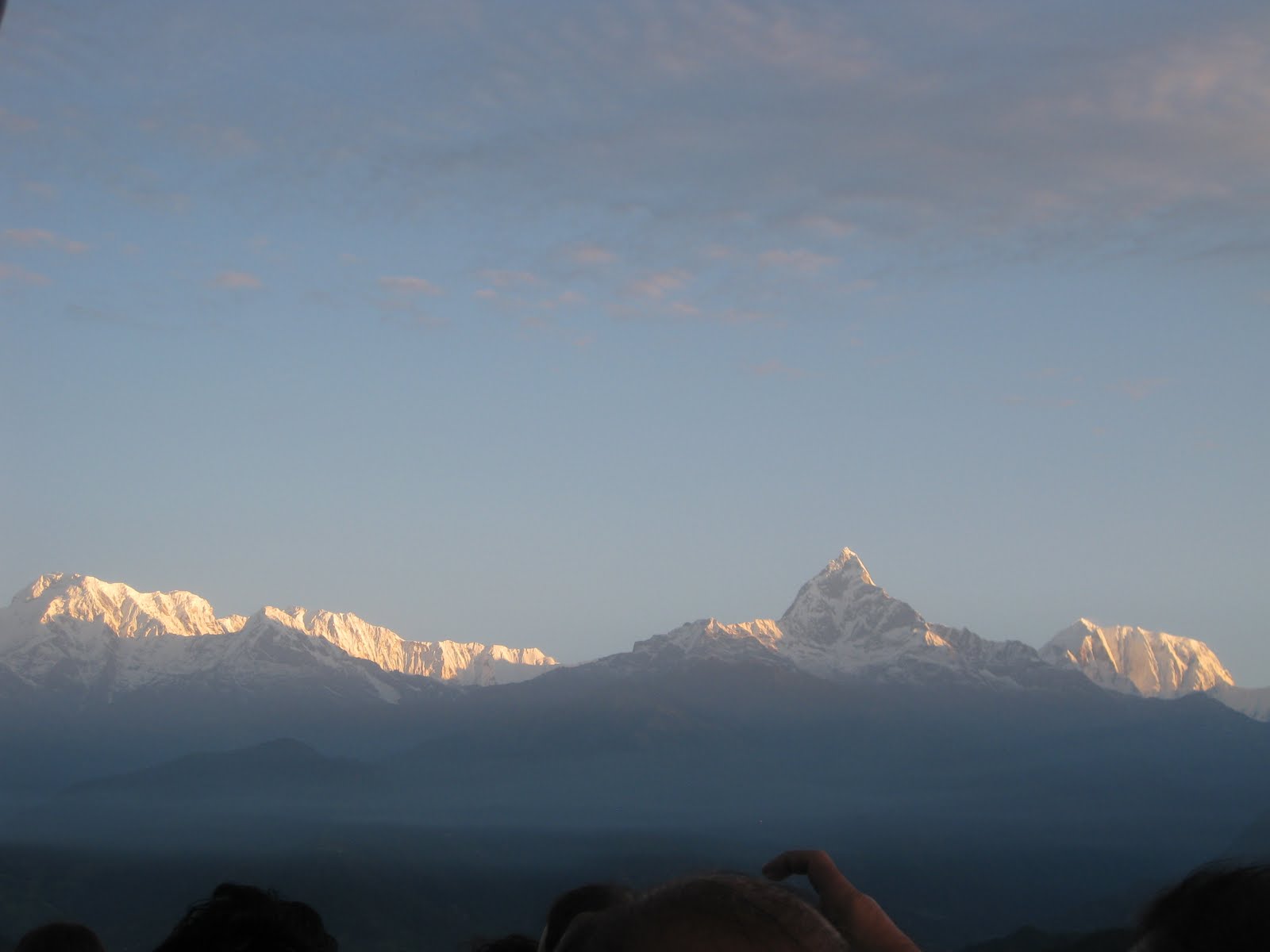
After two days, we book our ticket out of Pokhara. The entire town is geared towards the last stop before trekking the Annapurna Circuit but other than that, there is not a lot to do. I would have like to hiked out to the World Peace Pagoda but due to recent attacks on women, it is not suggested that women trek to it alone. Anxious to see the mountains which have been hidden under cloud cover every day, on the morning that we are flying out, I rise at 4:45 and take a thirty minute taxi up to Sarangkot, one of the closest viewpoints. I stand waiting in the darkness with a hundred other visitors. The mood is jovial, almost party like. At 6:10, the first glimpse of light illuminates one of the mountain peaks. As the sun slowly rises, the mountain range lights up. At heights of 6997 to 8167 meters, the peaks are breath taking. Camera click away non-stop. I try to capture this moment in my mind forever. By six-thirty, the sun has fully risen and my taxi driver urges me to leave in order to catch my flight back to Kathmandu.
An hour later, Mom and I are sitting in the airport restaurant. When we came in our airlines booth, Guna Air was not open despite the fact that every other airline was open. We decided to sit upstairs in the restaurant and have a coke and a coffee. Twenty minutes later, worried, I ask my mother to go check when Guna will open. She is halfway down the stairs when the waiter comes running out after her, telling her “Not open for ten minutes, go back and sit down.” He is very persistent, waving her back to our table. She obediently sits down. I am amazed that my mother obeyed, knowing her character. Eventually, however, we check in when the waiter tells us the booth is open.
After getting our boarding passes, we go through security. We are only carrying two small backpacks and do not have to check any luggage. Passing through the metal detector, I don't think that it is even plugged in. We are sent to the women's cubicle to be patted down and they casually look through Mom's bag that contained liquids, which they did not bat an eye lash at. Once in the waiting room, Mom decides to go to the toilet. We could smell it before we found it. The first toilet booth, a wooden door only has an unplugged big round hole where the door knob should be and it does not lock. The next one had no paper and no water. The sinks as usual was outside the toilet area and had not been washed in six years. And this is an airport! The keeper of this famous toilet came in and Mom asked her for soap. She pointed to a sliver of soap stuck to the wall. I guess she was supposed to wet her hands then take the soap. She might had done that if there had been any water.
Now for the flight. An experience of a lifetime. We walk over the tarmac, around another airplane, up some rickety tin steps than only one can get on at a time, frantically look for number eight and nine seats, only to have someone say “Free seating, free seating.” Then there are our bags. Since we carried our small backpacks we assumed that we would put them in an overhead compartment. There is no overhead, in fact the ceiling is just inches over our heads. The plane is an eighteen seater, nine on each side. No wider than six feet at most. We can see the two pilots siting in the front, even though we are seating way at the back. This was supposedly, when we booked tickets, a brand new plane. It didn't take long to figure out that this was a very old plane. A gorgeous Nepali flight attendant in a suit no less, said sweetly, “Fasten your seatbelts, please.” We had no sooner done that when the engines came on with a huge roar. As the wheels left the runway, Mom comments that she feels like we are being “shot out of a canon.” We hang on for dear life. Once in the air, we are offered a candy and a newspaper. Who can read ? Mom and I are hysterical with laughter. Side by side each other with a ten inch space between us, we laugh and laugh at this incredible experience.
But it is all worth it for the view. Now we know why we went straight up. Pokhara is down in a valley and surrounded by mountain ranges. I click one photo after the next of the snow-covered mountains that I had seen earlier in the morning. No sooner had we leveled out, we start to nosedive into into Kathmandu. Surprisingly, the landing is smooth, without a hitch. In twenty minutes, we covered the same distance that we drove by bus in seven hours two days before.
After a day's rest, we take a car and a driver to the ancient city of Bhaktapur. Bhaktapur is an amazing city. Mom and I spent the day walking the old cobble streets that are traffic free. It is like stepping back in time to the 1700's. We avoid the central Durbar square where they want ten dollars entry fee, a fortune compared to others that we have visited previously. Instead we get lost in the city, passing women knitting in the shade of their doorways or chatting with their neighbors. Men work on repairing the roads or building furniture. We visit potters square where the men and women have been making clay pots for hundreds of years. Later, we enjoy a cold beer and momos for lunch on the roof top of a small hotel and exhausted, we head back to Kathmandu.
We change hotels to move over to the Bodhnath Stupa. I want spend time with the Tibetans who come to here every day to walk clockwise around the Stupa. It is a huge white circular temple with a white dome topped with a four sided golden peak that has the infamous Buddhist eyes on each side. Long lines of prayer flags flutter in the wind. Maroon-robed Tibetan monks walk around the stupa, fingering their prayer beads, their lips moving quietly in prayer. Stooped whizzened worshipers twirl the hundreds of prayer wheels sitting in niches in the walls. The words Om Mani Padme Hum drone from a loudspeaker. A sudden burst of drums announces a funeral procession. We refrain from clicking our cameras in respect, as the tears run down my face at the sight of such naked pain.
At the end of ten days, we fly out of Nepal, sorry to leave and promising to come back. The friendly Nepalis have impressed us so much with their kindness. I want to come back with my kids and go trekking. But for now, Mom and I head for Bangladesh where I have some work to complete. But that is another story.
We spend some days in the city adjusting to being in Asia. It is a big change from Europe. Dusty roads, chaotic traffic, and air pollution. Kathmandu reminds me of being in Mexico city. Both cities lie in low valleys, trapping the air. Strangely, all this chaos is refreshing for us after being in Europe. Our senses are heightened as we dodge traffic and walk the narrow streets. We wander around Durbur square where former kings and queens were crowned and legitimized. It is the heart of the old town and filled with temples, terraced platforms and statues. Sadus approach us asking for money. Vendors too numerous to count try to sell us whatever trinket they are flogging, including flutes, tiger balm and jewelery. We soon tire of the bombardment and head back to our hotel.
After a couple of days, we decide to make a three day trip to Pokhara. Excited to get out of smoggy Kathmandu, we start out eagerly at seven am to catch our bus. We have paid five hundred rupees each for a non-air conditioned bus. There are about ten foreigners on the bus while the others were locals who I'm sure did not pay the same price. We start out merrily and in great spirits. For the first two hours we chatted and watched never-ending traffic. Eventually we leave the city limits and head into the hills, dashing along at the high speed of twenty kilometers an hour. A caravan of trucks travel in both directions. One truck decides to turn around in the middle of the road, holding up traffic on both sides oft the mountain pass.
For hours, I stare out the window. Women wash clothes in the mountain streams, carry water on their heads. Others pound rocks into gravel for the road construction that was underway.
The only men that I see are playing cards under trees. How did this division of labour come to be, I wonder. Our bus weaves through valleys, one after the other, up and down, passing beautiful lush steep terraces growing corn, wheat and okra. Banana trees border the road. Pokhara is five hundred meters below Kathmandu so the river that we are following is traveling in the same direction as us. As the river widens, there are more and more suspension bridges. Most are walkable. Others are just a suspension line with a rickety wooden basket dangling precariously. I shiver at the thought of falling into the rushing river gorge below.
As the heat heightens, our spirits begin to wane. If we keep the windows open, the dust flies in our faces; if we close it, we cook. At eleven o'clock, the bus makes a pit stop and we have to pay five rupees to pee in a latrine. And that payment does not ensure a clean venue. Need I say more. Afterward, I buy some bananas and a cucumber for a snack. Twenty minutes later, back on the bus. The heat grows. Mom dozes off intermittently, her head lolling with every curve. I grow lethargic, the sweat pouring down my back. After six hours, Mom and I decide that we will fly back to Kathmandu instead of taking the bus back.
After seven hours, we arrive in Pokhara through the industrial section. A city of 171,000. Pokhara is renown for a lovely lake and incredible mountain views. We get down from the bus and look for our prearranged hotel pickup. We've found that doing this eliminates a lot of tasseling from taxi drivers wanting a fare. Our glee at arriving turns to misery when we check into our hotel that is extremely isolated and up a road that is barely passable. But we are so exhausted that we don't have the energy to do anything about it today. We make the best of it until the morning when we change hotels.
One of the highlights of Pokhara over the next two days will be visiting the Tibetan village of Tashi Palkhel. Young monks sit around their gompa studying while old women circle it doing their prayers. Our driver shows us where a landslide wiped out a number of the homes in the village. The locals are extremely friendly. We stop for chai and chat with them in Hindi. Mom sketches a blind old man, who is thrilled to be the center of attention.
After two days, we book our ticket out of Pokhara. The entire town is geared towards the last stop before trekking the Annapurna Circuit but other than that, there is not a lot to do. I would have like to hiked out to the World Peace Pagoda but due to recent attacks on women, it is not suggested that women trek to it alone. Anxious to see the mountains which have been hidden under cloud cover every day, on the morning that we are flying out, I rise at 4:45 and take a thirty minute taxi up to Sarangkot, one of the closest viewpoints. I stand waiting in the darkness with a hundred other visitors. The mood is jovial, almost party like. At 6:10, the first glimpse of light illuminates one of the mountain peaks. As the sun slowly rises, the mountain range lights up. At heights of 6997 to 8167 meters, the peaks are breath taking. Camera click away non-stop. I try to capture this moment in my mind forever. By six-thirty, the sun has fully risen and my taxi driver urges me to leave in order to catch my flight back to Kathmandu.
An hour later, Mom and I are sitting in the airport restaurant. When we came in our airlines booth, Guna Air was not open despite the fact that every other airline was open. We decided to sit upstairs in the restaurant and have a coke and a coffee. Twenty minutes later, worried, I ask my mother to go check when Guna will open. She is halfway down the stairs when the waiter comes running out after her, telling her “Not open for ten minutes, go back and sit down.” He is very persistent, waving her back to our table. She obediently sits down. I am amazed that my mother obeyed, knowing her character. Eventually, however, we check in when the waiter tells us the booth is open.
After getting our boarding passes, we go through security. We are only carrying two small backpacks and do not have to check any luggage. Passing through the metal detector, I don't think that it is even plugged in. We are sent to the women's cubicle to be patted down and they casually look through Mom's bag that contained liquids, which they did not bat an eye lash at. Once in the waiting room, Mom decides to go to the toilet. We could smell it before we found it. The first toilet booth, a wooden door only has an unplugged big round hole where the door knob should be and it does not lock. The next one had no paper and no water. The sinks as usual was outside the toilet area and had not been washed in six years. And this is an airport! The keeper of this famous toilet came in and Mom asked her for soap. She pointed to a sliver of soap stuck to the wall. I guess she was supposed to wet her hands then take the soap. She might had done that if there had been any water.
Now for the flight. An experience of a lifetime. We walk over the tarmac, around another airplane, up some rickety tin steps than only one can get on at a time, frantically look for number eight and nine seats, only to have someone say “Free seating, free seating.” Then there are our bags. Since we carried our small backpacks we assumed that we would put them in an overhead compartment. There is no overhead, in fact the ceiling is just inches over our heads. The plane is an eighteen seater, nine on each side. No wider than six feet at most. We can see the two pilots siting in the front, even though we are seating way at the back. This was supposedly, when we booked tickets, a brand new plane. It didn't take long to figure out that this was a very old plane. A gorgeous Nepali flight attendant in a suit no less, said sweetly, “Fasten your seatbelts, please.” We had no sooner done that when the engines came on with a huge roar. As the wheels left the runway, Mom comments that she feels like we are being “shot out of a canon.” We hang on for dear life. Once in the air, we are offered a candy and a newspaper. Who can read ? Mom and I are hysterical with laughter. Side by side each other with a ten inch space between us, we laugh and laugh at this incredible experience.
But it is all worth it for the view. Now we know why we went straight up. Pokhara is down in a valley and surrounded by mountain ranges. I click one photo after the next of the snow-covered mountains that I had seen earlier in the morning. No sooner had we leveled out, we start to nosedive into into Kathmandu. Surprisingly, the landing is smooth, without a hitch. In twenty minutes, we covered the same distance that we drove by bus in seven hours two days before.
After a day's rest, we take a car and a driver to the ancient city of Bhaktapur. Bhaktapur is an amazing city. Mom and I spent the day walking the old cobble streets that are traffic free. It is like stepping back in time to the 1700's. We avoid the central Durbar square where they want ten dollars entry fee, a fortune compared to others that we have visited previously. Instead we get lost in the city, passing women knitting in the shade of their doorways or chatting with their neighbors. Men work on repairing the roads or building furniture. We visit potters square where the men and women have been making clay pots for hundreds of years. Later, we enjoy a cold beer and momos for lunch on the roof top of a small hotel and exhausted, we head back to Kathmandu.
We change hotels to move over to the Bodhnath Stupa. I want spend time with the Tibetans who come to here every day to walk clockwise around the Stupa. It is a huge white circular temple with a white dome topped with a four sided golden peak that has the infamous Buddhist eyes on each side. Long lines of prayer flags flutter in the wind. Maroon-robed Tibetan monks walk around the stupa, fingering their prayer beads, their lips moving quietly in prayer. Stooped whizzened worshipers twirl the hundreds of prayer wheels sitting in niches in the walls. The words Om Mani Padme Hum drone from a loudspeaker. A sudden burst of drums announces a funeral procession. We refrain from clicking our cameras in respect, as the tears run down my face at the sight of such naked pain.
At the end of ten days, we fly out of Nepal, sorry to leave and promising to come back. The friendly Nepalis have impressed us so much with their kindness. I want to come back with my kids and go trekking. But for now, Mom and I head for Bangladesh where I have some work to complete. But that is another story.
Tuesday, September 28, 2010

The good, the bad and the ugly: Turkey
One of the countries on our European leg that I was looking forward to the most was Turkey. I anticipated that Turkey was going to be different from the other countries that we had visited in Europe and I wondered if it would be closer to my Asian experiences. But this was not to be the case.
Turkey is the only country that spans two continents, Europe and Asia and thus, the city of Istanbul is half European, half Asian. Apparently it used to be a very corrupt country but then the government cracked down, bringing about huge changes. Now it is very modern, with an excellent infrastructure. (India could take some lessons here on the eve of the Commonwealth Games.) The roads and highways are in excellent condition and there is evidence of planning and wealth everywhere. It helps that Turkey is enjoying a surge in tourism which was very evident during our stay.
Turkey is a Muslim country and I found that the Turkish people rarely made eye contact nor smile. Part of me wonders if they are sick to death of tourists. I can't imagine what it is like to have a gazillion tourists three hundred and sixty five days a year. There is never a lull or down season. Brand new state of the art buses were everywhere. Cruise ships arrived daily. We even had to time our museum visits to avoid the crowds.
The first part of our stay was in the lovely Sebnem Hotel, a small hotel owned by a young man who is eeking out a living in a very hotel laden city. Every morning we were greeted with an unbelievable breakfast of homemade pastries, made fresh daily. He was extremely helpful and one of the rare ones with a smile for us.
We spent many days touring the incredible sights: the Blue Mosque, Santa Sophia, Dolmabahce Palace, the Grand Bazaar and the Spice Market. My Mom was particularly moved by our visit to Santa Sophia. It is a former Christian church, dating 500 DC. Absolutely enormous in size with beautiful frescoed ceilings and mosaics. Unfortunately the frescoes were peeling and any symbol of Christianity that was removable was removed. Sadly, unlike our visit to the palace where people were yelled at for putting a finger on a wall, tourists in Santa Sophia are allowed to tramp through in great hoards without any care or thought for its protection.
One of the highlights of the week was a quick two day trip to Assos. John and I went by bus, over seven hours. The bus was state of the art, even with wireless internet and incredible free food service on board. I felt like I was on a plane. A young man in a crisp white shirt, complete with a bow-tie and black pants pushed his little trolley up and down the aisle every couple of hours. When we arrived in the closest town to Assos, we had to take a dolmus (a little mini-bus) the rest of the way and I made friends with an old man who was thrilled to explain his village heritage to a Canadian. Assos is a primitive stone village, which is also the site of ancient ruins. John and I trekked the hills and even hitch-hiked our way back to the village. Sadly, we wished that we had had one more day there.
Each country seems to bring out different feelings in me. One night an incident brought this to a head. John and I were walking up a hill to go out for dinner. We were walking about 1 ½ feet apart, when all of a sudden, a young man came running down the hill towards me. In the blink of an eye, with his hand flat, he whacked my upper chest, just below my throat. The stinging slap resounded in the night as he continued running down the hill. I was deeply shaken and to this day wonder why he did this. Was he trying to snatch my travel purse, which was over my head and shoulder? Was he making a statement about non-Islamic women, even though I was very conservatively dressed? Or was he simply deranged? I guess I'll never know.
The day before we left, in celebration of John's birthday, we decided to splurge and go for a Turkish bath. The Cagaloglu Hamam was constructed in 1741 and is still running today. After paying our forty Euros each (remember that I said splurge), John and I parted to go to our respective sections, men's and women's. It was an amazing hour long experience for me as I underwent a total exfoliating, massage and scrub, all while lying on huge marble platform with steam rising up to the beautiful mosaic domed ceiling. Other women lay around me in various stages of their bath, which is administered by women dressed in the old style full body, one piece bathing suits. Eucalyptus wafted through the air. As I lay there, condensation from the ceiling dripped on my face. After each step, my woman poured bowl fulls of warm water over my head. Finishing up in the sauna, I emerged from the Hamam, feeling very relaxed, much like a wet noodle.
One resonating sight that still remains with me is seeing women dressed in full burkhas: black from head to toe, with only a slit to see through. Not that every women was dressed like this, far from it. But there were enough to make it was a common sight. I often saw two or three women, with one husband, walking around or sitting in parks, totally covered. On our flight out of Istanbul, a woman in full burkha, further covered the slit for her eyes with yet another black cover when she went to the toilet. I have no idea how she ever saw how to get to the toilet at the back of the plane. And when we arrived in Doha, she and her family were all whisked away in a Mercedes taxi, directly from the plane. They did not board the crowded shuttle bus that took us into the airport terminal. I know that some women do chose to cover themselves up willingly but there are many others who have no choice. I often wonder how they see the world through a wall of black and what they are feeling underneath.
But what I missed most of all was being able to look into their eyes and connect, as women do all over the world.
Turkey is the only country that spans two continents, Europe and Asia and thus, the city of Istanbul is half European, half Asian. Apparently it used to be a very corrupt country but then the government cracked down, bringing about huge changes. Now it is very modern, with an excellent infrastructure. (India could take some lessons here on the eve of the Commonwealth Games.) The roads and highways are in excellent condition and there is evidence of planning and wealth everywhere. It helps that Turkey is enjoying a surge in tourism which was very evident during our stay.
Turkey is a Muslim country and I found that the Turkish people rarely made eye contact nor smile. Part of me wonders if they are sick to death of tourists. I can't imagine what it is like to have a gazillion tourists three hundred and sixty five days a year. There is never a lull or down season. Brand new state of the art buses were everywhere. Cruise ships arrived daily. We even had to time our museum visits to avoid the crowds.
The first part of our stay was in the lovely Sebnem Hotel, a small hotel owned by a young man who is eeking out a living in a very hotel laden city. Every morning we were greeted with an unbelievable breakfast of homemade pastries, made fresh daily. He was extremely helpful and one of the rare ones with a smile for us.
We spent many days touring the incredible sights: the Blue Mosque, Santa Sophia, Dolmabahce Palace, the Grand Bazaar and the Spice Market. My Mom was particularly moved by our visit to Santa Sophia. It is a former Christian church, dating 500 DC. Absolutely enormous in size with beautiful frescoed ceilings and mosaics. Unfortunately the frescoes were peeling and any symbol of Christianity that was removable was removed. Sadly, unlike our visit to the palace where people were yelled at for putting a finger on a wall, tourists in Santa Sophia are allowed to tramp through in great hoards without any care or thought for its protection.
One of the highlights of the week was a quick two day trip to Assos. John and I went by bus, over seven hours. The bus was state of the art, even with wireless internet and incredible free food service on board. I felt like I was on a plane. A young man in a crisp white shirt, complete with a bow-tie and black pants pushed his little trolley up and down the aisle every couple of hours. When we arrived in the closest town to Assos, we had to take a dolmus (a little mini-bus) the rest of the way and I made friends with an old man who was thrilled to explain his village heritage to a Canadian. Assos is a primitive stone village, which is also the site of ancient ruins. John and I trekked the hills and even hitch-hiked our way back to the village. Sadly, we wished that we had had one more day there.
Each country seems to bring out different feelings in me. One night an incident brought this to a head. John and I were walking up a hill to go out for dinner. We were walking about 1 ½ feet apart, when all of a sudden, a young man came running down the hill towards me. In the blink of an eye, with his hand flat, he whacked my upper chest, just below my throat. The stinging slap resounded in the night as he continued running down the hill. I was deeply shaken and to this day wonder why he did this. Was he trying to snatch my travel purse, which was over my head and shoulder? Was he making a statement about non-Islamic women, even though I was very conservatively dressed? Or was he simply deranged? I guess I'll never know.
The day before we left, in celebration of John's birthday, we decided to splurge and go for a Turkish bath. The Cagaloglu Hamam was constructed in 1741 and is still running today. After paying our forty Euros each (remember that I said splurge), John and I parted to go to our respective sections, men's and women's. It was an amazing hour long experience for me as I underwent a total exfoliating, massage and scrub, all while lying on huge marble platform with steam rising up to the beautiful mosaic domed ceiling. Other women lay around me in various stages of their bath, which is administered by women dressed in the old style full body, one piece bathing suits. Eucalyptus wafted through the air. As I lay there, condensation from the ceiling dripped on my face. After each step, my woman poured bowl fulls of warm water over my head. Finishing up in the sauna, I emerged from the Hamam, feeling very relaxed, much like a wet noodle.
One resonating sight that still remains with me is seeing women dressed in full burkhas: black from head to toe, with only a slit to see through. Not that every women was dressed like this, far from it. But there were enough to make it was a common sight. I often saw two or three women, with one husband, walking around or sitting in parks, totally covered. On our flight out of Istanbul, a woman in full burkha, further covered the slit for her eyes with yet another black cover when she went to the toilet. I have no idea how she ever saw how to get to the toilet at the back of the plane. And when we arrived in Doha, she and her family were all whisked away in a Mercedes taxi, directly from the plane. They did not board the crowded shuttle bus that took us into the airport terminal. I know that some women do chose to cover themselves up willingly but there are many others who have no choice. I often wonder how they see the world through a wall of black and what they are feeling underneath.
But what I missed most of all was being able to look into their eyes and connect, as women do all over the world.
Subscribe to:
Posts (Atom)